
You already know what happened last Tuesday.
A product you've been sourcing from RSR for two years quietly dropped $18 at Lipsey's. You didn't know. You ordered 12 units from RSR like you always do. And now you're sitting on inventory with $216 less margin than you could have had — on a single PO.
Multiply that across every distributor, every week, all year. That's not bad luck. That's an information gap. And information gaps in this business are expensive.
Most gun store owners are making buying decisions based on memory, habit, or whatever rep they talked to last. Nothing against the reps — they're doing their job. But your job is to run a profitable business. And you can't do that if you're flying blind.
That's exactly why we built Market Intelligence into Mission Control.
What Market Intelligence Actually Does
Mission Control connects your Odoo ERP to every major distributor — RSR Group, Lipsey's, Sports South, Chattanooga Shooting Supplies, Davidson's, and Zanders — and pulls live data continuously. Not a morning sync. Not a nightly batch job. Continuously.
Market Intelligence takes all of that data and turns it into something actionable: a dashboard that tells you what's happening across your distributor network right now, what it means for your margins, and what you should do about it.
Price Gap Analysis
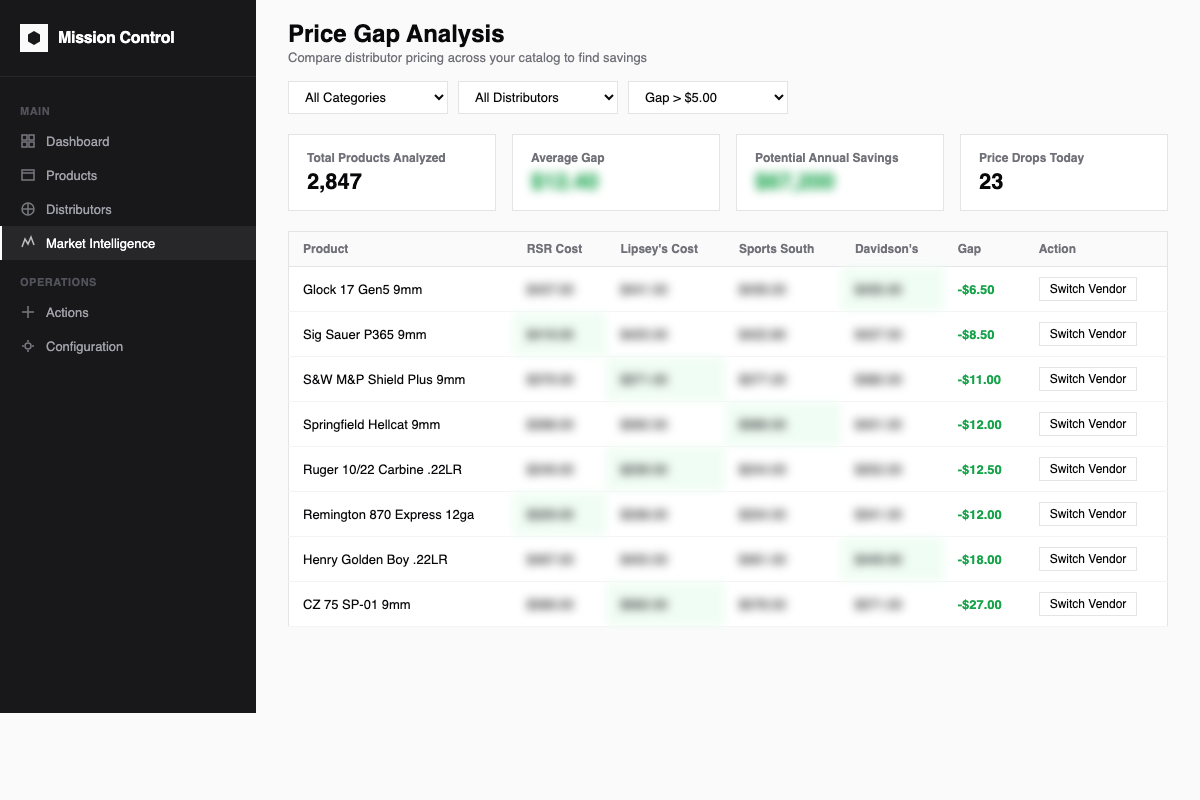
This is the one that makes buyers stop and stare.
Price Gap Analysis compares your current cost on every SKU across every connected distributor and surfaces the delta. Not buried in a spreadsheet. Right there, sorted by the size of the gap.
If RSR has a Glock 17 for $549 and Davidson's has it for $531, you see that gap. If you're currently buying from RSR, the system flags it. You click. You see the full picture. You make the call.
But it goes further than just distributor-to-distributor comparison. It compares your costs against market averages — so you can see where you're consistently overpaying across the board, not just on individual SKUs. That's where the real money is. Not the one-off wins. The systemic ones.
Most stores leave 2-4% margin on the table across their entire purchasing volume just by never having time to compare prices manually. At $2M in annual cost-of-goods, that's $40K-$80K. Not a typo.
New Arrivals Detection
Here's a problem nobody talks about: the products you don't know exist.
Distributors add new SKUs constantly. New manufacturer relationships, new configurations, products you've never stocked. Most stores find out about new products when a customer asks for them, or when they're scrolling a distributor catalog on a slow Tuesday.
That's backward. You should know what's new before your customers do.
New Arrivals Detection automatically surfaces every new product across your connected distributors the moment it appears in their inventory. Organized by distributor, sortable by category. If a new Taurus model shows up at Sports South, you see it. If Lipsey's picks up a new suppressor line, you see it.
Being first to stock a hot new SKU matters. First-mover advantage is real in retail. This puts you in a position to act on it.
Back-in-Stock Alerts
Anyone who's sold firearms for more than six months has a mental list of "the stuff I can never get."
Maybe it's a specific Sig variant that's been allocation-only for eight months. Maybe it's a defensive ammo SKU that's been out since everyone stocked up again. You've had customers asking. You've been checking manually. Nothing.
Back-in-Stock Alerts watches those products automatically. The moment a distributor shows inventory — even a handful of units — you get the notification. You can act before it disappears again.
This isn't just about customer service, although filling a backorder the day something comes back in is genuinely impressive. It's about not losing sales you already earned. The customer asked. You said "I'll let you know." Now you actually will.
Price Drop Notifications
When Chattanooga drops their price on a product you carry, you're notified. What you do with that information is up to you:
- Lower your retail price to stay competitive and move units faster
- Keep your retail where it is and pocket the better margin
- Stock up at the lower cost before it adjusts back
The point is you have a choice. Right now, you might not even know the drop happened until your next order goes through and you notice the invoice looks different.
Lowest Price Tracking
Simple. Powerful. Obvious value.
For every product in your system, Mission Control knows which distributor has the lowest cost at any given moment. That data is visible on every product record, in your purchasing workflows, and across the Market Intelligence dashboard.
When your purchasing manager is building a PO, they're not opening four browser tabs to compare prices. The system tells them where to buy and what it costs. Every time. No exceptions, no missed comparisons because someone was busy.
Margin Opportunity Identification
Margin Opportunity Identification runs an algorithm across your product catalog, comparing your current retail pricing against live distributor costs. When a distributor cost drops and your retail price hasn't moved, you've got a margin opportunity — you're making more than you intended on that product, and the system surfaces it.
The system doesn't make the decision for you. It makes sure you know the decision is available. Most stores miss these entirely because they only review margins during quarterly accounting, not in real time.
Distributor Velocity Scoring (A-D Grading)
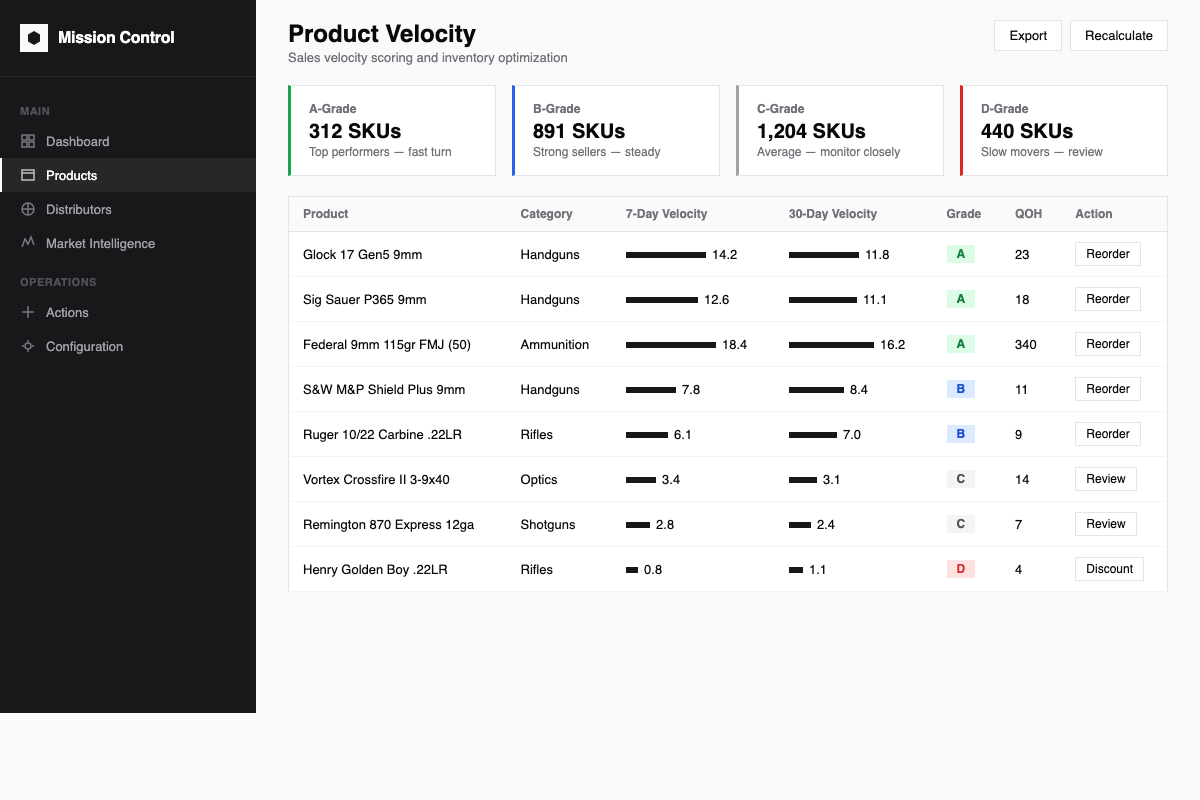
Every product in your catalog gets graded. A, B, C, or D.
A-grade products are your fast movers. These are the SKUs flying off the shelf, the ones driving revenue, the ones where stockouts actually hurt. B and C are mid-velocity — solid movers but not urgent. D-grade is your slow stock and dead weight.
You stock A-grade products aggressively. You set tighter reorder points. You make sure you never run out. You audit D-grade products. You decide whether to discount and clear them or stop reordering. You stop tying up cash in things that don't move.
Most gun stores have 15-25% of their inventory value sitting in D-grade products. That's cash that could be deployed into A-grade movers. Distributor Velocity Scoring makes it visible.
Trending Products Dashboard
The Trending Products Dashboard pulls market movement signals across your distributor network and surfaces what's hot right now.
This is different from your own velocity data. Your velocity shows what's selling in your store. Trending shows what's moving across the market — products with strong demand signals regardless of whether you're currently carrying them.
Timing matters in retail. Knowing something is trending three weeks before it becomes a headline item gives you a real edge.
This Lives Inside Your Odoo
Market Intelligence isn't a separate tool. It's not another dashboard you have to log into. It's a native module inside Mission Control — which is a native part of your Odoo ERP. The data connects directly to your purchasing workflows, your inventory records, your product catalog, and your margin reporting.
One login. One system. Real data. That's how this is supposed to work.
See It For Yourself
If you're running an FFL dealership and you're managing distributor relationships manually, the Market Intelligence dashboard will change how you buy.
Mission Critical BPS builds and manages Odoo ERP systems specifically for firearms retailers. We're not a generic ERP firm that added a few gun store features. This is all we do, and we've built Mission Control around the actual problems firearms retailers face.
Schedule a demo at missioncriticalbps.com or reach out directly to talk about what Market Intelligence would look like for your operation.
Stop guessing. Your competitors won't.